Isentropic Expansion Efficiency of a Miniature Air Turbine | Fall 2025
Project Description
This project involved designing a laboratory experiment to measure the isentropic expansion efficiency of a miniature air turbine. The goal was to study how turbine performance changes with inlet pressure and applied load. The experiment applied steady-flow energy equations and ideal-gas isentropic relations learned in Thermodynamics to connect theory with real system behavior.
Individual Contributions
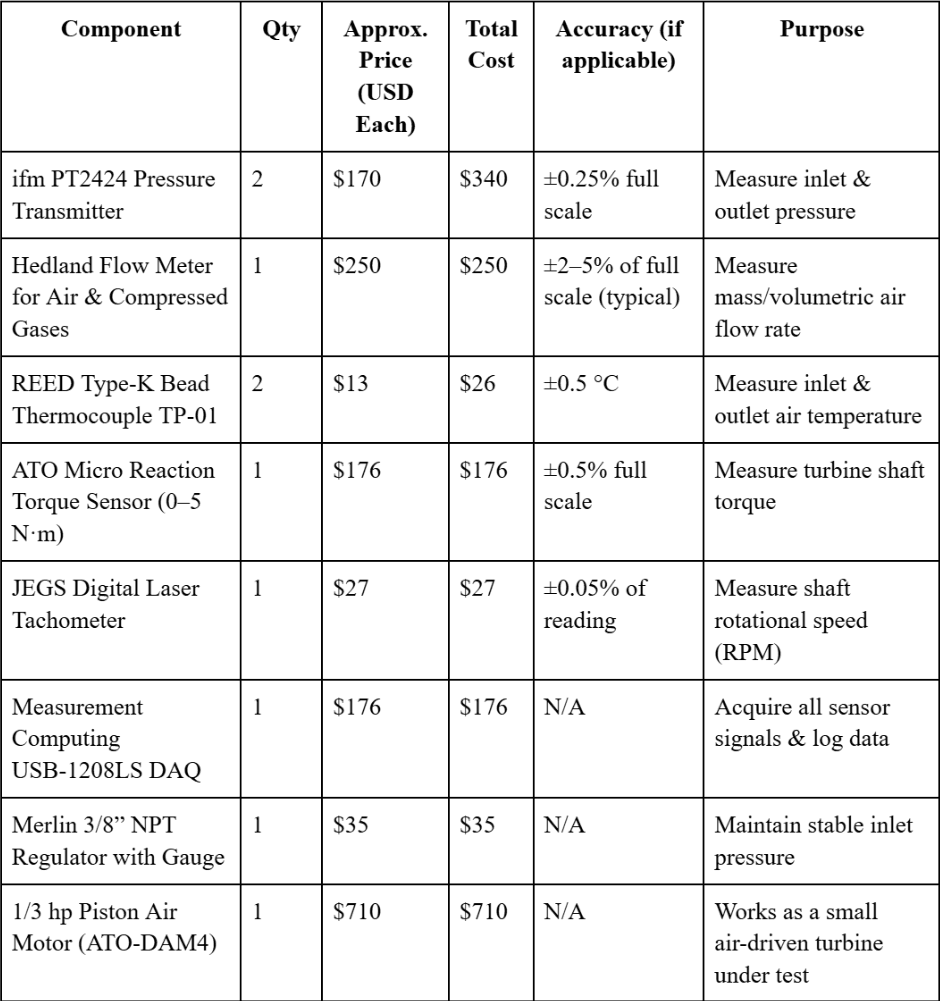
Developed the hardware description and performed cost analysis. This consisted of sensor selection and system layout.
Created the performance indicator and defined the key evaluation questions
Analyzed measurement uncertainty and identified sensors with the greatest impact on efficiency accuracy
Results
Observed clear trends between turbine efficiency, pressure ratio, and mechanical load
Performed uncertainty analysis resulting in an average relative efficiency error of approximately 2.2%
Confirmed that selected sensors were suitable for accurate turbine performance evaluation
Demonstrated real-world losses that prevent ideal isentropic turbine behavior
Project received the highest score in the class with a final grade of 96%
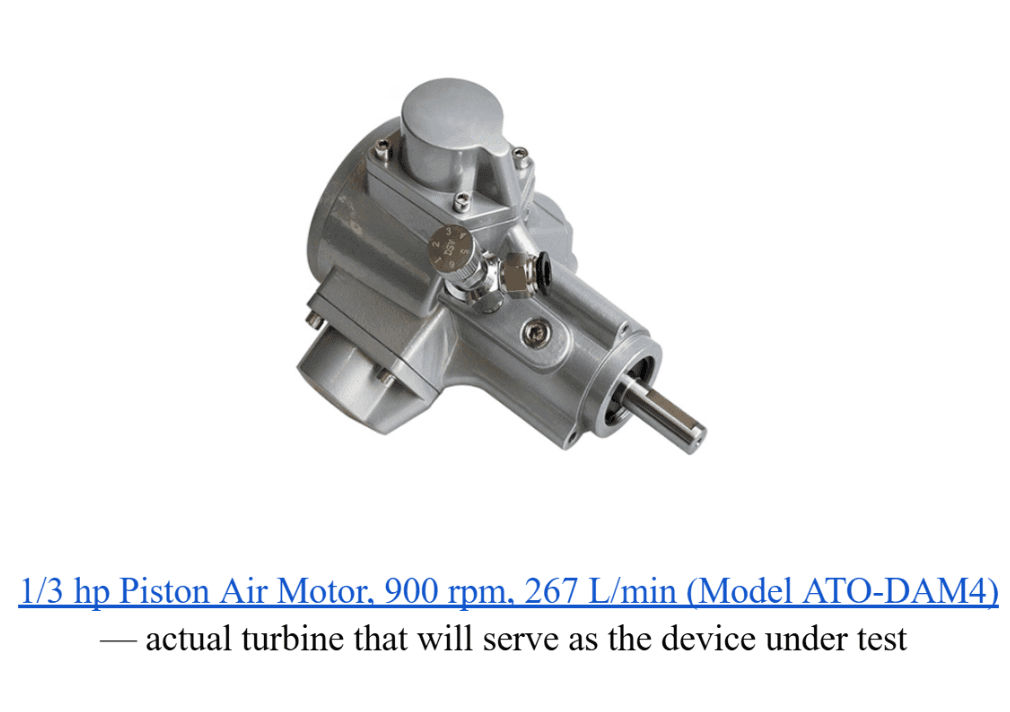
Turbine
Solution Methods
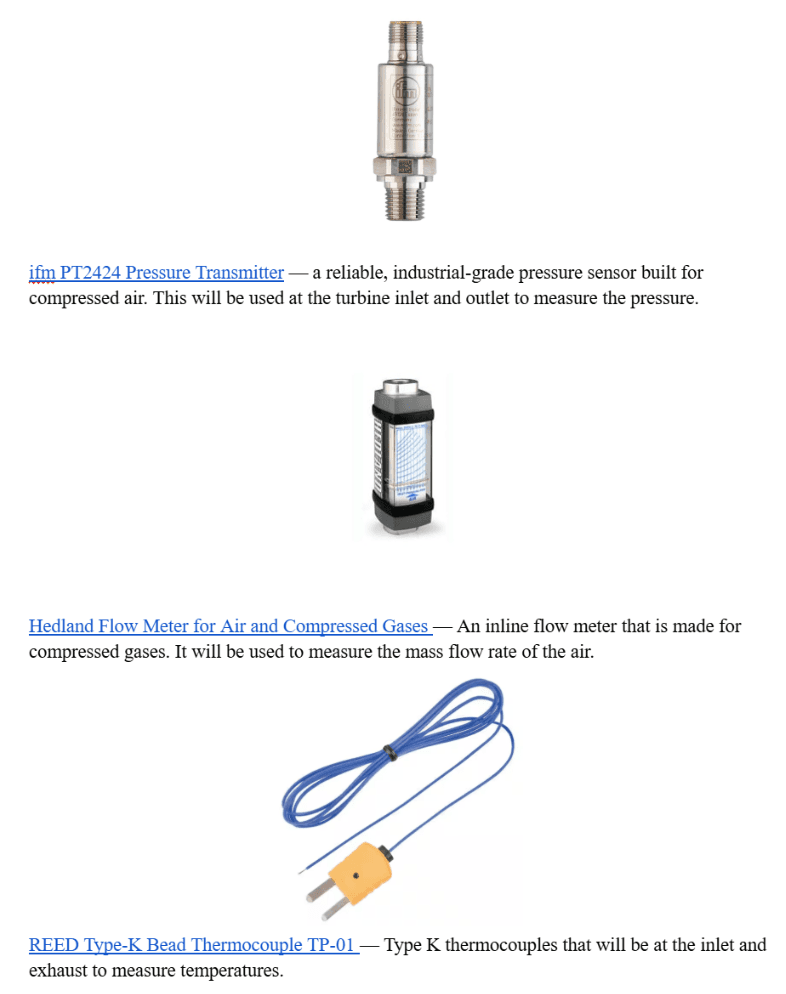
Designed an experimental setup using pressure, temperature, mass flow rate, torque, and rotational speed measurements
Calculated actual shaft work from measured torque and angular velocity
Determined ideal turbine work using isentropic relations
Computed turbine efficiency across multiple operating conditions
Established a repeatable procedure to ensure consistent data collection and analysis
Comprehensive Component Cost Table
Component List